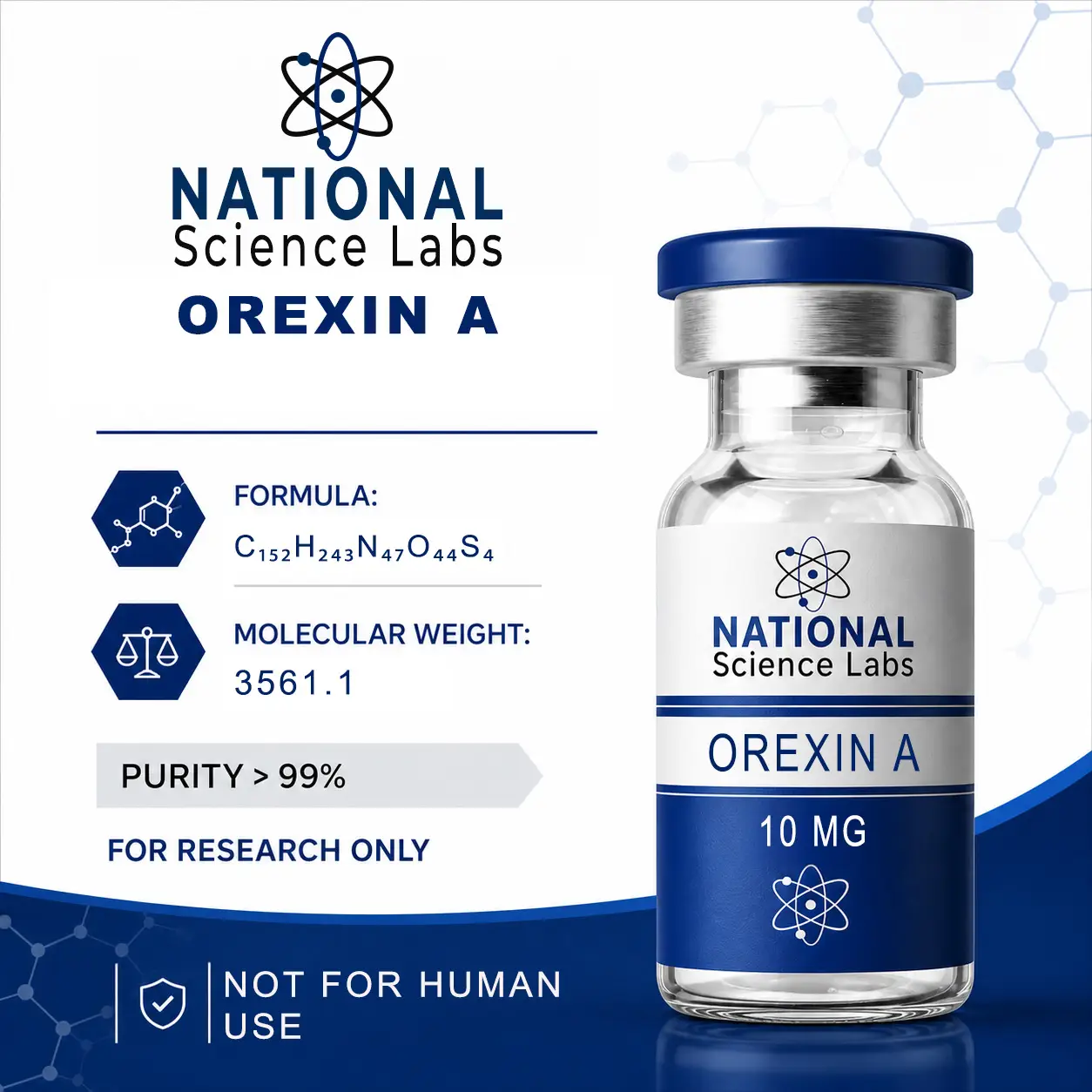


Researchers utilize Orexin A to activate OX1R and OX2R with high affinity, observing excitatory influences on arousal-promoting neurons in brainstem and hypothalamic targets. Pre-clinical findings in rat models indicate dose-dependent increases in wakefulness, reduced transitions to sleep states, and enhanced firing in locus coeruleus neurons following central administration.
This neuropeptide facilitates investigation of orexin-mediated pathways that stabilize vigilance, suppress paradoxical sleep, and coordinate homeostatic responses in experimental settings.
Scientific Overview of Orexin A Applications
Pre-clinical models illustrate Orexin A’s potent excitatory effects on orexin receptor mechanisms:
- High-affinity binding to OX1R and OX2R, promoting neuronal firing in arousal nuclei such as the locus coeruleus and tuberomammillary nucleus, leading to increased wakefulness in rodent models. https://pubmed.ncbi.nlm.nih.gov/10712652/
- Suppression of sleep states and prolongation of arousal through projections to brainstem monoaminergic systems, as observed in acute intracerebroventricular administration studies.
- Modulation of stress adaptation and autonomic responses, integrating vigilance with hypothalamic-pituitary-adrenal axis activity in challenge paradigms. https://www.mdpi.com/2227-9059/12/2/448
- Contribution to reward and motivation pathways via projections to ventral tegmental area and nucleus accumbens, supporting behavioral adaptation in addiction-related preclinical models. https://pubmed.ncbi.nlm.nih.gov/35126069/
- Enhancement of vigilance homeostasis and reduction in sleep instability, with roles in age-related arousal circuit dynamics in rodent systems. https://pubmed.ncbi.nlm.nih.gov/35201886/
- Examination of excitatory signaling that differs from Orexin B in receptor selectivity profiles, emphasizing OX1R dominance in certain arousal and stress contexts.
For additional context on orexin neuropeptides, receptor subtypes, and arousal neurobiology, refer to the Peptide Sciences or About Peptides sections.
Why Investigators Select National Science Labs Orexin A
National Science Labs manufactures Orexin A under stringent GMP-compliant protocols to ensure batch-to-batch consistency and reliability for pre-clinical protocols. Independent third-party testing verifies each lot for:
- Purity ≥99.9% by HPLC
- Structural identity confirmation
- Complete Certificate of Analysis (CoA) documentation provided per batch
For Research Use Only. This product is supplied exclusively for in vitro and in vivo pre-clinical research by qualified investigators. Statements about this peptide have not been evaluated by the FDA.
Initiate Your Orexin A Research Protocol
Source high-purity Orexin A from current limited batches to ensure optimal stability and performance in orexin receptor signaling and wakefulness regulation studies.