Quick Answer
What Are Collagen Peptides?
Collagen peptides are short chains of amino acids derived from collagen proteins through controlled hydrolysis processes. Researchers study collagen peptides to better understand protein structure, peptide characterization, molecular interactions, biomaterials science, and analytical testing methodologies.
Collagen Peptides Research: Structure, Characterization & Scientific Applications
Collagen is one of the most extensively studied structural proteins in biological systems. As scientific interest in protein chemistry, biomaterials research, and peptide science continues to expand, collagen peptides remain an important area of investigation across multiple research disciplines.
Researchers study collagen peptides to better understand molecular structure, amino acid composition, hydrolysis processes, protein characterization, and analytical testing methods. These investigations contribute to broader scientific efforts involving protein science, tissue engineering research, biomaterials development, and molecular biology.
This article explores the science behind collagen peptides, including their molecular characteristics, peptide classification, laboratory analysis methods, and current areas of scientific research interest.
What Are Collagen Peptides?
Collagen peptides are short amino acid chains produced through the hydrolysis of collagen proteins. During hydrolysis, larger collagen molecules are broken into smaller peptide fragments that can be more easily analyzed and characterized in laboratory settings.
Researchers investigate collagen peptides because their structural properties make them useful subjects within protein chemistry, peptide science, biomaterials research, and analytical testing programs.
The study of collagen peptides contributes to scientific understanding of protein structure, molecular interactions, amino acid composition, and biological material characterization.
Major Types of Collagen Studied in Scientific Research
Scientists have identified numerous collagen types, each possessing distinct structural characteristics and biological functions. Research involving collagen peptides frequently references several well-characterized collagen categories.
| Collagen Type | Research Focus | Scientific Interest |
|---|---|---|
| Type I | Structural protein studies | Biomaterials research |
| Type II | Protein characterization | Molecular biology research |
| Type III | Structural analysis | Protein science investigations |
Collagen Peptides vs Collagen: A Research Perspective
Researchers often distinguish between intact collagen proteins and collagen peptides when conducting analytical studies. While both originate from the same protein source, they differ in molecular size, structural complexity, and laboratory evaluation methods.
| Research Characteristic | Collagen | Collagen Peptides |
|---|---|---|
| Molecular Structure | Large protein molecule | Hydrolyzed peptide fragments |
| Analytical Evaluation | Protein characterization | Peptide analysis |
| Research Applications | Protein science | Peptide research |
Molecular Characteristics of Collagen Peptides
One of the primary areas of scientific interest surrounding collagen peptides involves their molecular composition and structural characteristics. Collagen proteins are composed of amino acids arranged in repeating sequences that contribute to their unique physical and biochemical properties.
Through controlled hydrolysis processes, larger collagen molecules can be converted into smaller peptide fragments. Researchers often study these peptide structures to better understand molecular weight distribution, sequence composition, stability characteristics, and protein-fragment interactions.
Common analytical parameters evaluated during collagen peptide research include:
- Molecular weight profiles
- Amino acid composition
- Peptide sequence analysis
- Protein fragmentation patterns
- Structural integrity
- Hydrolysis efficiency
- Batch consistency
Advances in analytical chemistry and protein characterization technologies continue to improve the scientific understanding of collagen-derived peptide structures.
Hydrolysis and Peptide Production Research
Hydrolysis represents a fundamental process in collagen peptide research. During hydrolysis, larger protein structures are broken into smaller peptide fragments through controlled enzymatic or chemical methods.
Researchers investigate hydrolysis processes to better understand how processing conditions influence peptide size, sequence distribution, structural characteristics, and analytical properties.
Factors commonly evaluated in hydrolysis research include:
- Processing parameters
- Enzyme selection
- Reaction conditions
- Peptide yield
- Molecular weight distribution
- Purification methods
- Analytical consistency
These studies contribute to broader scientific efforts involving protein engineering, biomaterials research, and peptide manufacturing methodologies.
Analytical Testing Methods for Collagen Peptide Research
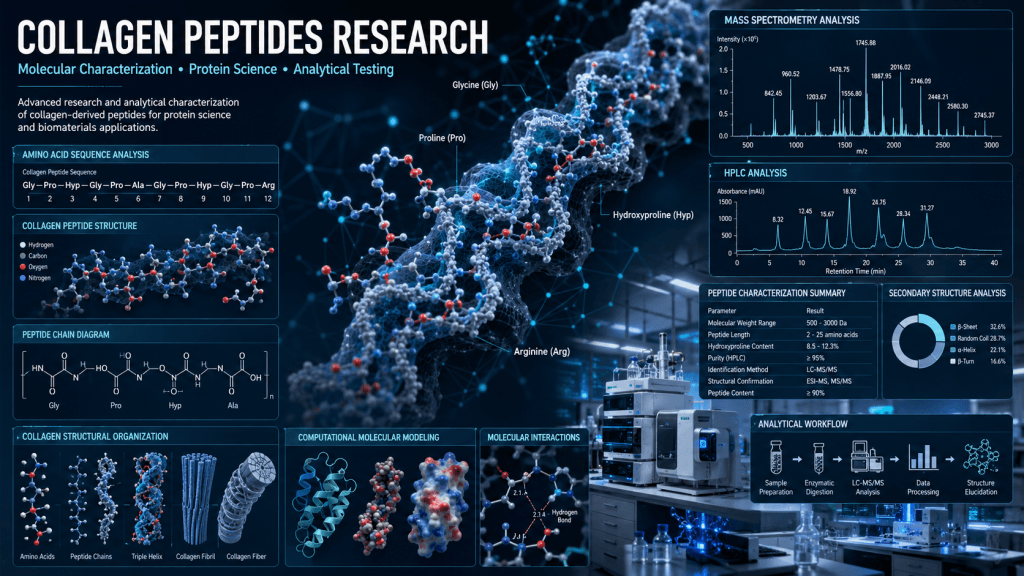
Analytical testing is an essential component of modern peptide science. Researchers utilize multiple laboratory techniques to verify identity, evaluate purity, characterize molecular structures, and assess overall sample quality.
High-Performance Liquid Chromatography (HPLC)
HPLC is frequently used to evaluate purity, identify impurities, and assess peptide consistency across production batches. Chromatographic analysis remains one of the most widely adopted methods in peptide characterization research.
Mass Spectrometry (MS)
Mass spectrometry enables detailed molecular analysis by measuring mass-to-charge ratios and verifying molecular identity. Researchers often rely on mass spectrometry when confirming peptide composition and structural characteristics.
Amino Acid Analysis
Amino acid profiling provides valuable insight into peptide composition and helps researchers evaluate structural consistency across samples.
Stability Testing
Stability studies help researchers understand how peptide materials respond to environmental factors such as temperature, moisture, and storage conditions.
Together, these analytical techniques support reliable scientific investigations and help maintain research quality standards.
Quality Standards and Peptide Characterization
Quality assurance remains a critical aspect of peptide research. Researchers evaluating collagen peptide materials frequently review analytical documentation and testing data to verify material identity and consistency.
Common quality indicators include:
- Certificate of Analysis (COA)
- Third-party laboratory testing
- Purity verification
- Identity confirmation
- Batch traceability
- Manufacturing documentation
- Analytical validation reports
These quality-control measures help support reproducibility and scientific transparency across laboratory investigations.
Biomaterials and Protein Science Research
Collagen peptides continue to attract interest within biomaterials science and protein research due to their structural properties and biological origin.
Researchers investigate collagen-derived materials in studies involving:
- Protein engineering
- Biomaterials development
- Molecular modeling
- Structural biology
- Tissue scaffold research
- Protein interaction analysis
- Advanced materials science
These investigations contribute to broader scientific efforts focused on understanding protein-based materials and molecular architecture.
Current Trends in Collagen Peptide Research
As analytical technologies continue to advance, researchers gain access to increasingly sophisticated tools for studying protein-derived peptides and molecular structures.
Several research areas continue to generate scientific interest:
- Advanced protein characterization
- Peptide sequence analysis
- Computational molecular modeling
- Biomaterials innovation
- Protein engineering research
- Analytical testing advancements
- High-resolution structural analysis
- Laboratory validation methodologies
These emerging technologies continue to expand scientific understanding of collagen-derived peptide systems and their analytical characteristics.
Frequently Asked Questions
What are collagen peptides?
Collagen peptides are short amino acid chains produced through the hydrolysis of collagen proteins and studied within protein science, biomaterials research, and peptide characterization investigations.
How are collagen peptides produced?
Collagen peptides are generated through hydrolysis processes that break larger collagen proteins into smaller peptide fragments for analytical evaluation and research purposes.
How are collagen peptides analyzed in laboratories?
Researchers commonly utilize HPLC, mass spectrometry, amino acid analysis, and stability testing to evaluate peptide identity, composition, and quality.
Why do researchers study collagen peptides?
Scientists investigate collagen peptides to better understand protein structure, molecular interactions, peptide characterization, biomaterials science, and analytical chemistry applications.
What quality standards are important for collagen peptide research?
Researchers often evaluate Certificates of Analysis, purity testing, identity verification, third-party laboratory testing, and manufacturing documentation.
Scientific Resources and References
- PubMed: Collagen Peptide Research Publications
- PubMed: Protein Characterization Studies
- PubMed: Biomaterials Research
- National Center for Biotechnology Information (NCBI)
- National Institutes of Health (NIH)
- FDA Science and Research Resources
Research Use Only Notice
The information presented in this article is provided solely for educational and scientific research purposes.
Products offered by National Science Labs are intended exclusively for laboratory research, analytical testing, and scientific investigation. They are not intended for human consumption, medical use, therapeutic application, diagnosis, treatment, mitigation, cure, or prevention of any disease or medical condition.
Any discussion of molecular properties, analytical testing methods, protein characterization, biomaterials research, or peptide science is provided strictly within the context of laboratory research.
