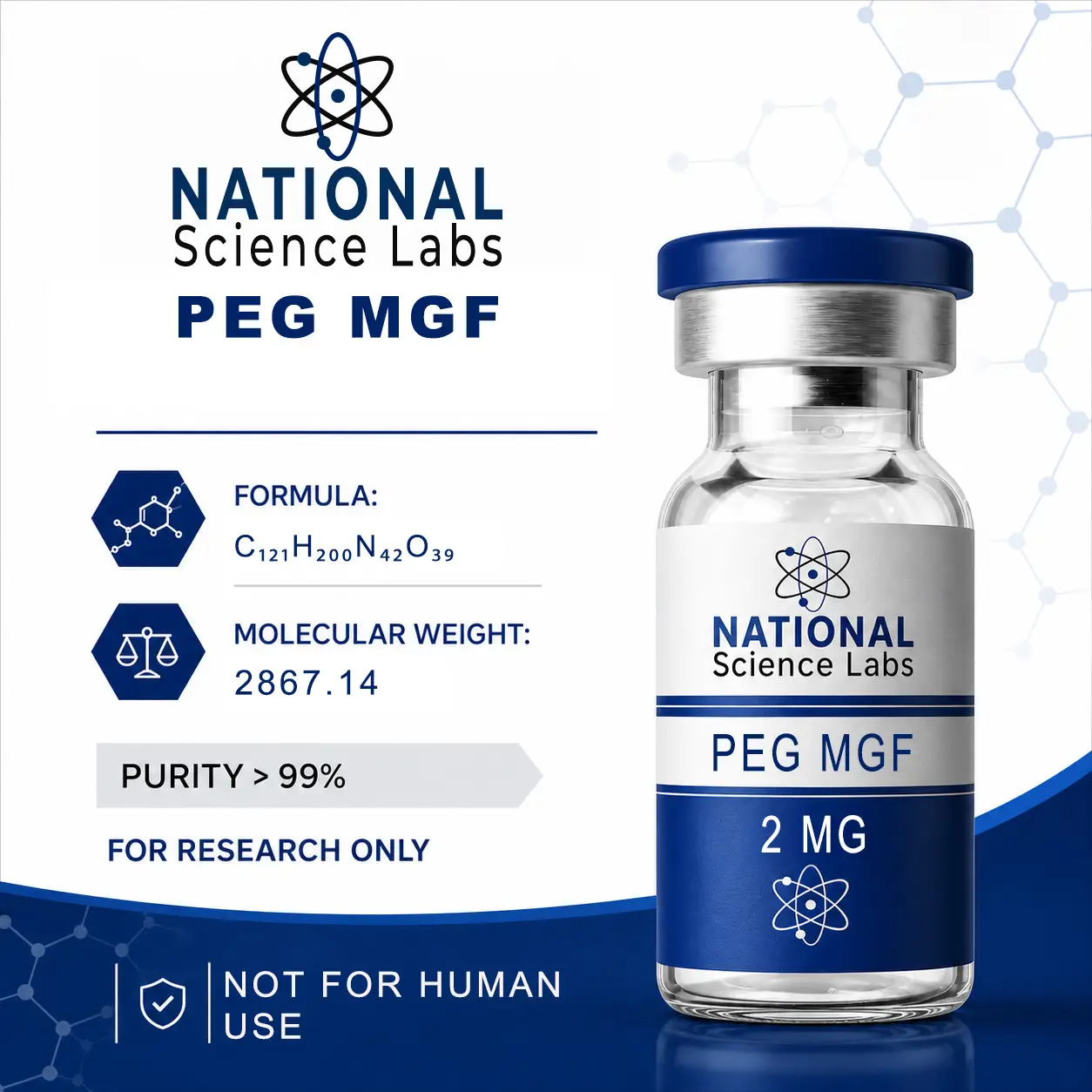
Researchers employ PEG-MGF to investigate its dramatically extended plasma half-life (from minutes for native MGF to several days) resulting from PEG conjugation, enabling systemic administration with sustained bioactivity. Pre-clinical observations in rodent models indicate superior tissue distribution, enhanced satellite cell activation, and significant cross-sectional area increases in both injected and contralateral muscles following overload or injury protocols.
This pegylated isoform facilitates examination of prolonged regenerative signaling, reduced dosing frequency requirements, and whole-body repair dynamics without the limitations of native MGF’s rapid clearance.
Scientific Overview of PEG-MGF Applications
Pre-clinical models demonstrate PEG-MGF’s pharmacokinetic and regenerative advantages:
- Extended plasma half-life (2–5 days) via PEG shielding from proteases, allowing sustained systemic exposure and reduced clearance compared to native MGF. https://pubmed.ncbi.nlm.nih.gov/17122378/
- Promotion of satellite cell proliferation and muscle hypertrophy through systemic delivery, achieving 20–40% increases in muscle cross-sectional area in overload and injury rodent models.
- Superior contralateral muscle repair effects via diffusion, outperforming local native MGF administration in whole-body regeneration studies.
- Neuroprotective and regenerative actions in stroke, spinal cord injury, and ALS models through sustained satellite cell and tissue support. https://pubmed.ncbi.nlm.nih.gov/16012928/
- Cardioprotective effects and enhancement of bone regeneration in preclinical stress and injury paradigms. https://pubmed.ncbi.nlm.nih.gov/20096320/
- Valuable utility in sarcopenia, muscular dystrophy, cachexia, and neurological injury research due to extended-release profile.
For broader context on pegylated growth factors, mechano growth factor signaling, and regenerative pathways in pre-clinical research, refer to the Peptide Sciences or About Peptides sections.
Why Investigators Select National Science Labs PEG-MGF
National Science Labs manufactures PEG-MGF under rigorous GMP-compliant protocols to ensure batch-to-batch consistency and reliability for pre-clinical experiments. Independent third-party testing verifies each lot for:
- Purity ≥99.9% by HPLC and SEC (size-exclusion chromatography)
- Structural identity and PEG conjugation confirmation via MALDI-TOF MS
- Complete Certificate of Analysis (CoA) documentation provided per batch
For Research Use Only. This product is supplied exclusively for in vitro and in vivo pre-clinical research by qualified investigators. Statements about this peptide have not been evaluated by the FDA.
Initiate Your PEG-MGF Research Protocol
Source high-purity PEG-MGF from current limited batches to ensure optimal stability and performance in extended-release muscle regeneration studies.