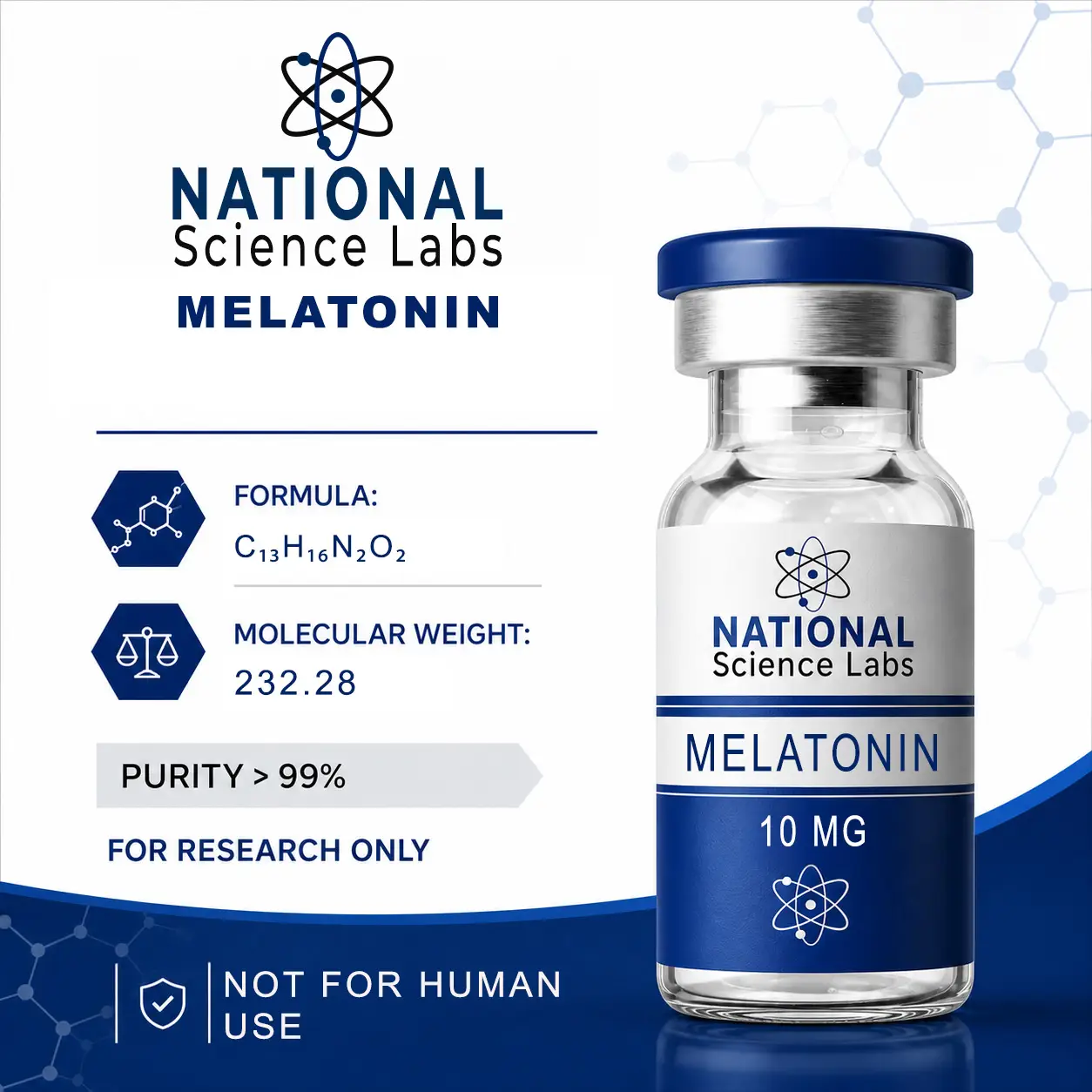
Researchers employ Melatonin to investigate its role as the primary synchronizer of circadian rhythms via MT1/MT2 receptors in the suprachiasmatic nucleus, observing phase-shifting effects on sleep-wake cycles and metabolic timing. Pre-clinical observations in neuronal and peripheral tissue models indicate direct scavenging of reactive oxygen and nitrogen species, upregulation of antioxidant enzymes, and preservation of mitochondrial membrane potential under oxidative challenge.
This indoleamine facilitates examination of dual chronobiotic and cytoprotective mechanisms, contributing to cellular resilience and adaptive responses in aging or stress-related research contexts.
Scientific Overview of Melatonin Applications
Pre-clinical models demonstrate Melatonin’s engagement with regulatory and protective pathways:
- Activation of MT1/MT2 receptors in the suprachiasmatic nucleus to synchronize circadian rhythms and influence sleep architecture in rodent and cellular systems. https://pubmed.ncbi.nlm.nih.gov/23691095/
- Direct free radical scavenging (5–15× more effective than glutathione against hydroxyl radicals) and upregulation of antioxidant enzymes (glutathione peroxidase, superoxide dismutase) in oxidative stress models. https://pubmed.ncbi.nlm.nih.gov/26721517/
- Preservation of mitochondrial membrane potential, ATP production, and bioenergetic function in stress-challenged cellular systems. https://pubmed.ncbi.nlm.nih.gov/33708101/
- Modulation of inflammatory and apoptotic signaling through SIRT1 and Nrf2 pathways in neurodegenerative and aging models.
- Support for investigations into tissue-specific protective effects in ischemia-reperfusion and metabolic stress paradigms.
- Examination of chronobiotic influences on neuroendocrine and metabolic homeostasis in multi-organ systems.
For additional context on circadian hormone signaling, antioxidant mechanisms, and mitochondrial protection in pre-clinical research, refer to the Peptide Sciences or About Peptides sections.
Why Investigators Select National Science Labs Melatonin
National Science Labs manufactures Melatonin under rigorous GMP-compliant protocols to ensure batch-to-batch consistency and reliability for pre-clinical experiments. Independent third-party testing verifies each lot for:
- Purity ≥99.9% by HPLC
- Structural identity confirmation via mass spectrometry
- Complete Certificate of Analysis (CoA) documentation provided per batch
For Research Use Only. This product is supplied exclusively for in vitro and in vivo pre-clinical research by qualified investigators. Statements about this compound have not been evaluated by the FDA.
Initiate Your Melatonin Research Protocol
Source high-purity Melatonin from current limited batches to ensure optimal stability and performance in circadian and antioxidant signaling studies.