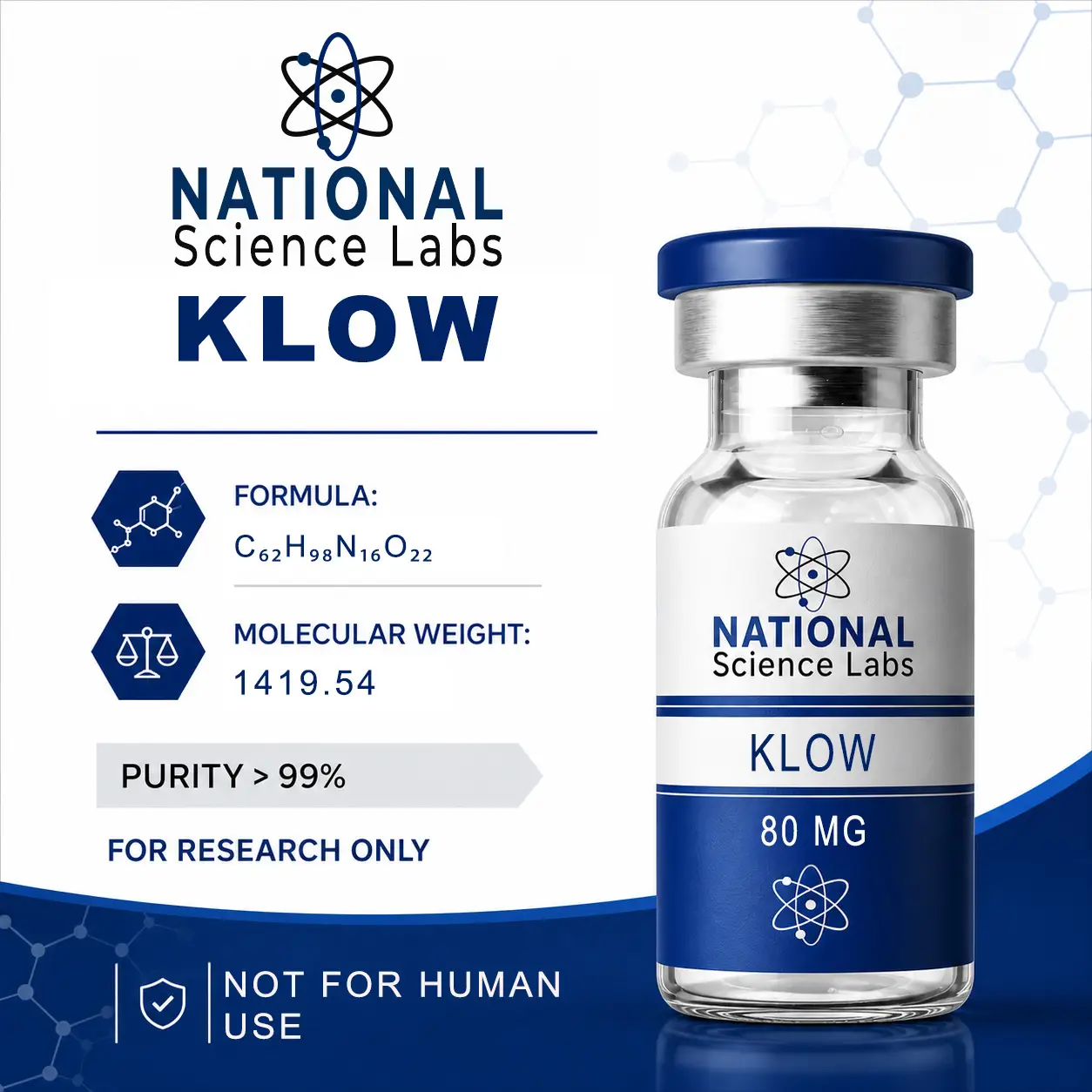
Researchers apply KLOW to investigate synergistic interactions among its components, observing enhanced cellular migration, collagen organization, and reduced inflammatory signaling in injury models. Pre-clinical findings in rodent systems indicate amplified angiogenic responses, improved epithelial barrier support, and modulation of pro-inflammatory cascades following combined exposure.
This formulation facilitates examination of integrated regenerative pathways, where individual peptides contribute complementary effects on tissue remodeling and immune modulation under stress or injury conditions.
Scientific Overview of KLOW Blend Applications
Pre-clinical models demonstrate the combined engagement of KLOW components with regenerative and anti-inflammatory mechanisms:
- Promotion of tendon, ligament, and gastrointestinal tissue repair through VEGF upregulation and nitric oxide pathway modulation by BPC-157. https://pubmed.ncbi.nlm.nih.gov/21030658/
- Enhancement of actin sequestration, cell migration, and angiogenesis in wound healing models via TB-500 (Thymosin β4 fragment). https://pubmed.ncbi.nlm.nih.gov/17537101/
- Stimulation of collagen synthesis, extracellular matrix remodeling, and dermal fibroblast activity by GHK-Cu. https://pubmed.ncbi.nlm.nih.gov/26380504/
- Suppression of NF-κB activation, cytokine production, and mucosal inflammation through PepT1-mediated uptake of KPV in intestinal models. https://pubmed.ncbi.nlm.nih.gov/18061177/
- Synergistic amplification of regenerative and anti-inflammatory effects in multi-pathway studies of musculoskeletal and epithelial injury models.
- Support for investigations into coordinated modulation of inflammatory infiltrates, MPO activity, and tissue integrity in colitis and wound paradigms.
For broader insights into multi-peptide blends, regenerative signaling, and anti-inflammatory mechanisms in pre-clinical research, refer to the Peptide Sciences or About Peptides sections.
Why Investigators Select National Science Labs KLOW Blend
National Science Labs manufactures KLOW under rigorous GMP-compliant protocols to deliver batch-to-batch consistency and reliability for pre-clinical experiments. Independent third-party testing verifies each lot for:
- Purity ≥99.9% by HPLC (compositional assay for individual components)
- Structural and ingredient identity confirmation via mass spectrometry
- Complete Certificate of Analysis (CoA) documentation provided per batch
For Research Use Only. This product is supplied exclusively for in vitro and in vivo pre-clinical research by qualified investigators. Statements about this compound have not been evaluated by the FDA.
Initiate Your KLOW Blend Research Protocol
Source high-purity KLOW from current limited batches to ensure optimal stability and performance in tissue regeneration and anti-inflammatory studies.